Nobody in this industry wants to talk straight about cost, so I will. I own a production company and a studio, I have priced this from every side of the table, and the honest answer is that a video podcast costs one of three things: your time, an hourly rate, or a partnership. Each has a real price and a right buyer.
Here is the breakdown I wish someone had handed me years ago.
What does it cost to DIY a video podcast?
DIY looks free and is the most expensive option on this list for a working expert, because it is paid in the one currency you cannot buy more of: your hours.
Start with the gear. A watchable video podcast needs a real camera, real microphones, lighting, a space that does not echo, and the software to pull it together. Do it right and you have made a serious equipment investment before recording a single minute. Do it cheap and it shows on camera, which defeats the purpose: production quality is a proxy for professionalism, fair or not, and buyers read it that way.
Then the part nobody budgets: the learning curve. Audio engineering, lighting, framing, editing, packaging, publishing, distribution. Each is a craft people do full time. You will spend months getting competent and the results will still look like year one, because they are. And every hour you spend learning to color-correct is an hour taken from the highest-value work in your business: being the expert clients pay for.
DIY makes sense for one buyer: the person with far more time than money, who genuinely enjoys production. If you bill by the hour or run a company, run the math on what those hours cost you. It is usually brutal.
What does hourly studio rental cost?
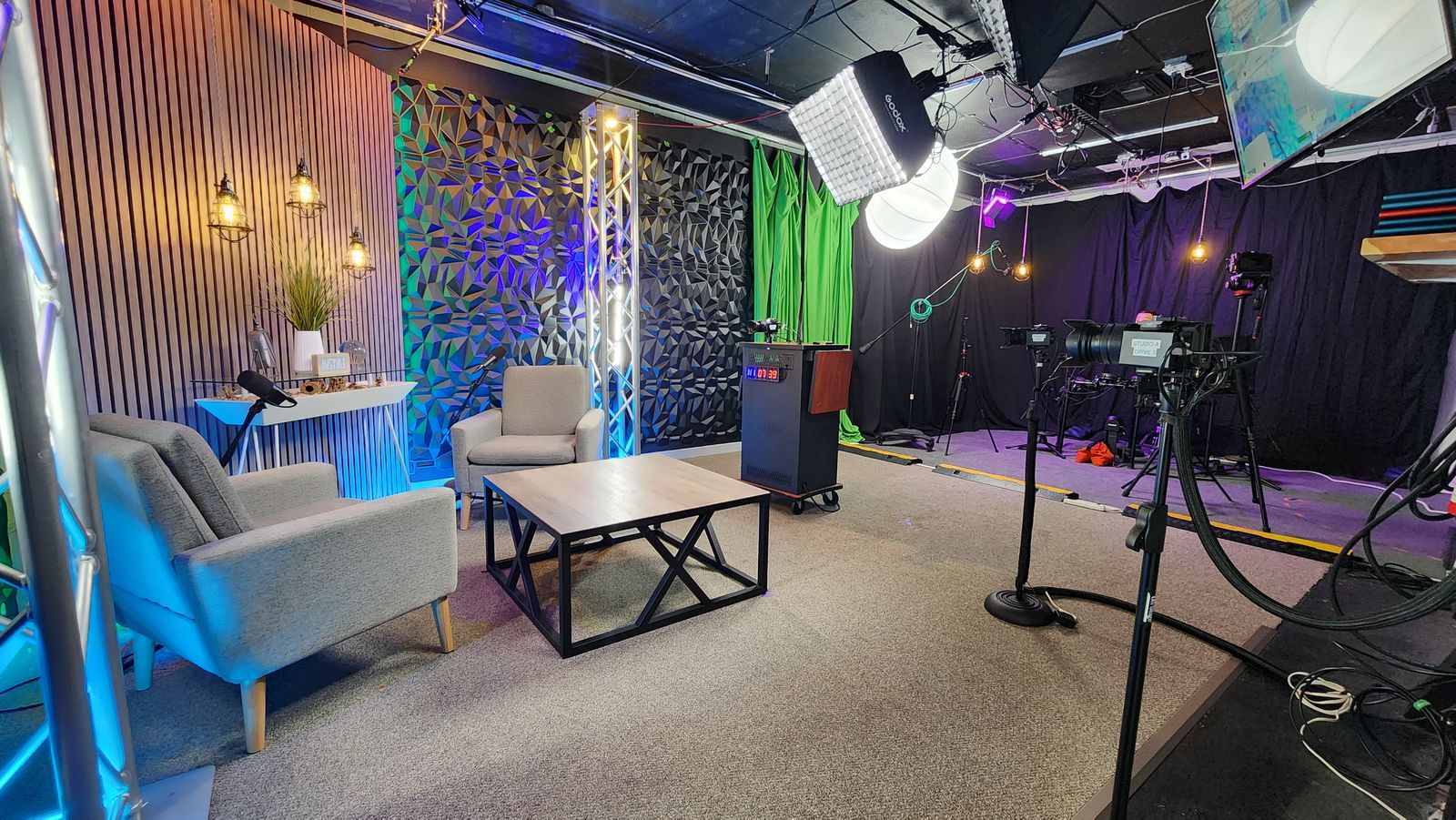
A professional podcast studio removes the entire gear and setup problem for an hourly rate. At our studio, San Diego Podcast Studios, that rate is $250 an hour, bundles save up to 20 percent when you record more, and session packages start at $500.
What the rate buys is everything the DIY route spends months assembling: broadcast-quality cameras, professional audio, designed sets, and an engineer running it all so you can focus on talking. You walk in, record, and walk out with professional footage the same day. Packages layer in the post-production, editing, thumbnails, clips, so you can leave with finished episodes instead of raw files.
Rental is the right answer for the expert who wants professional quality without owning the problem, and who is willing to drive their own strategy: choosing topics, planning episodes, handling publishing and distribution, keeping the cadence alive. The studio solves production. It does not solve the system.
What does a full production partner cost?
Market-wide, agency episode editing runs from roughly $300 to $1,000 per episode depending on scope and polish, and ongoing production retainers broadly land in the four figures monthly. That is the going rate for taking the production job off your plate entirely.
At that tier you should expect more than editing: planning support, consistent turnaround, packaging, and distribution handling. The spread in the market is wide because the offers are wide. Some shops are pure post-production, cutting whatever you send them. Others run the whole pipeline. When you compare quotes, compare what is actually included, because a cheap edit with no strategy behind it is not a bargain. It is a polished version of the post-and-hope problem.
Which brings up the question a smart buyer should ask before any of these numbers: production of what, exactly? An edited episode is a deliverable. It is not a result. If nobody decided why that episode exists, who it reaches, and what it moves them to do, you are paying good money to make noise in higher resolution.
What does Icon charge?
We do not sell a menu, so I cannot give you a price list, and that is deliberate. Icon scopes every engagement around the outcome you are after, not a stack of deliverables, so the pricing follows the outcome.
Here is why. The Icon Growth System is not an editing service. You record one day a month and the system turns it into YouTube videos built to rank in search, 12 to 20 clips, and your own show, distributed across every lane your buyers look. Two clients can want that machine for very different destinations, and the destination determines the build. Scoping both the same way would shortchange one of them.
So the honest answer on our pricing: it depends on where you are going. The Audit tells you where you stand. A meeting tells you what the build looks like.
What does a video podcast actually return?
The return, done right, is authority that converts: inbound demand, and a show that can pay for itself directly. Here is what that looks like in real numbers from shows built and run on the system.
A health expert with deep credentials and no content machine now sits in the top 1 percent of health video podcasts, built on consistent long-form engineered around what viewers already search. Another show went from launch to first dollars in under 30 days, because monetization was designed in before the first episode went live, not bolted on after. And one client’s audience converted three ways at once: $65K across sponsorships, guest fees, and licensing. That last one matters because it shows what authority actually is: an asset with multiple income streams attached, not a marketing expense.
I will be straight about the other side too: results like these are outputs of the system, not promises. Your numbers depend on your niche, your offer, and your starting point. A show with no strategy returns nothing at any price point, which is why the cheapest option that does not work is always the most expensive one you can buy.
So before you spend a dollar on any of the three paths, find out what your starting point actually is. Take the 5-Minute Authority Audit.